Britannia Academics

This is UK university application form with pen and clipboard representing step-by-step admission process guide

Share On Social Media

A Step-by-Step Guide to UK University Application Process [2026]

Applying to a UK university involves these key steps: researching courses, checking entry requirements, writing a personal statement, securing a reference, submitting your application, preparing for interviews, responding to offers, and applying for student finance. This guide covers every step with deadlines, insider tips, and expert advice for both domestic and international applicants.

Whether you’re applying for the first time or reapplying after a gap year, getting the process right from the start is critical. Mistakes at any stage can cost you a place at your target university.

Step 1: Research Universities and Courses

This is the step most applicants rush – and the one that sets the stage for every decision that follows. The UK has over 130 universities, each with different strengths, teaching styles, campus cultures, and graduate outcomes.

What to compare when choosing a UK university:

  • Subject-specific rankings: A university ranked 40th overall might rank 5th in your subject. Always check subject league tables, not just overall university rankings.
  • Course structure: Does the course offer work placements? Is it taught or research-led? Can you specialise in your area of interest?
  • Location and cost of living: London is significantly more expensive than cities like Sheffield, Nottingham, and Leeds, all of which host excellent universities.
  • Graduate outcomes: Check the percentage of graduates who are employed or in further study within 15 months of graduating. This data is published via the

For guidance on matching your course choice to your career ambitions, see: How to Choose a UK University Based on Your Career Goals.

If you’re still deciding on a subject, this resource identifies the most employable courses right now: High-Demand Degrees in the UK Job Market 2026

Strategy tip: You can apply to up to five courses. Use a mix – one or two aspirational choices, two realistic matches, and at least one safe option where you comfortably exceed the

Step 2 - Understand Entry Requirements Before You Apply

Entry requirements are non-negotiable. Applying to a course you don’t meet the requirements for wastes your time and choice.

Each course, and most universities and colleges, has different requirements – usually a mix of qualifications, subjects, or exam grades.

Typical UK entry requirements include:

  • A-Levels (for UK domestic students): Usually 3 A-Levels, with specific grade requirements like AAB or ABB.
  • International Baccalaureate (IB): Accepted by virtually all UK universities, typically requiring 32–38 points depending on the course.
  • English language proficiency: International students must provide an IELTS, TOEFL, PTE Academic, or equivalent test score. Most universities require an IELTS score of 6.0–7.0 overall. Some universities also accept an MOI (Medium of Instruction) certificate, meaning you can apply without taking extra language tests.
  • Admissions tests: Competitive courses like Medicine (UCAT), Law (LNAT), and Oxbridge subjects (MAT, TSA, BMAT) require separate tests in addition to qualifications.

Check each university’s official course page individually – requirements can differ even for the same course at different institutions.

For international applicants, the landscape is shifting. Stay informed with: Future Trends in UK Higher Education for International Students in 2026.

Step 3: Write a Personal Statement That Stands Out

Your personal statement is the most important piece of your application. It is your only direct opportunity to speak to the academics deciding whether to offer you a place – and admissions tutors typically spend only two minutes reading each one.

What admissions tutors want to see:

  • Genuine, specific curiosity for the subject – not generic enthusiasm
  • Evidence of reading, projects, or experiences that go beyond your school curriculum
  • Reflective thinking: not just what you did, but what you learned from it
  • Skills developed through extracurricular activities that relate to your chosen course

What to avoid:

  • Clichéd openings: “I have always been passionate about…” is the most overused phrase in personal statements. Start with substance.
  • Naming a specific university: Your statement goes to all five choices simultaneously. Mentioning one university by name will immediately undermine your application.
  • Plagiarism: The admissions officer uses plagiarism-detection software. Copied content results in the immediate cancellation of your entire application.

Step 4: Arrange a Strong Academic Reference

Your personal statement is the most important piece of your application. It is your only direct opportunity to speak to the academics deciding whether to offer you a place – and admissions tutors typically spend only two minutes reading each one.

What admissions tutors want to see:

  • Genuine, specific curiosity for the subject – not generic enthusiasm
  • Evidence of reading, projects, or experiences that go beyond your school curriculum
  • Reflective thinking: not just what you did, but what you learned from it
  • Skills developed through extracurricular activities that relate to your chosen course

What to avoid:

  • Clichéd openings: “I have always been passionate about…” is the most overused phrase in personal statements. Start with substance.
  • Naming a specific university: Your statement goes to all five choices simultaneously. Mentioning one university by name will immediately undermine your application.
  • Plagiarism: The admissions officer uses plagiarism-detection software. Copied content results in the immediate cancellation of your entire application.

Step 5: Prepare for Interviews and Admissions Tests

Not every course requires an interview, but competitive programmes – Medicine, Law, Oxbridge subjects, and some Architecture courses – almost always do.

Admissions test timeline:

Most admissions tests are taken in October or November, before the January application deadline. Register early – spaces fill up quickly.

  • UCAT – Medicine and Dentistry
  • LNAT – Law (specific universities)
  • MAT – Oxford Mathematics
  • ENGAA / NSAA – Cambridge Engineering and Natural Sciences

Practise out loud. Record yourself. Seek feedback from teachers or mentors. The candidates who perform best in interviews are those who have thought deeply about why they want to study the subject, not just what grade they achieved in it.

Interview preparation by type:

  • Oxford and Cambridge: Academic discussions designed to test how you think, not what you have memorised. Prepare by discussing your subject with teachers and working through unseen problems aloud.
  • Medical school MMIs: Rotating mini-interview stations assessing clinical reasoning, communication, and ethical judgement.
  • Other university interviews: Often conversational, reviewing your personal statement and exploring subject knowledge.

Critical: Your personal statement may serve as the basis for your interview. Know every claim you made in it and be prepared to expand in depth. Practise answering out loud – not just in your head.

Step 6: Receive and Respond to University Offers

Once universities have reviewed your application, they will send one of two types of responses:

  • Unconditional offer: Your place is confirmed with no further requirements.
  • Conditional offer: Your place is secured once you meet specific conditions – typically exam grades or an English language test score.

When responding to offers, you have two choices:

  • Firm choice: Your first-choice university. You will be enrolled here if you meet the entry conditions.
  • Insurance choice: Your backup. You will join this institution if you miss your Firm choice conditions but meet the Insurance offer requirements.

Choose your Insurance offer carefully. It should be a course you are genuinely happy to attend, with entry requirements slightly below your Firm choice.

Step 7: Apply for Student Finance and Scholarships

Student funding runs parallel to your application – not after it. Student Finance England (and equivalent bodies in Scotland, Wales, and Northern Ireland) provides tuition fee loans and maintenance loans.

Applications typically open in the spring before your course starts.
  • Apply as early as possible: Finance processing takes several weeks. Late applications mean starting the term without funds in your account.
  • Scholarships and bursaries: Many universities offer merit-based or needs-based awards. Check the financial support pages of your target universities and apply separately to each scheme.
  • External scholarships: International students should explore government scholarships from their home country alongside UK-based awards such as Chevening Scholarships and Commonwealth Scholarships.

Common Mistakes That Cost Applicants Their Place

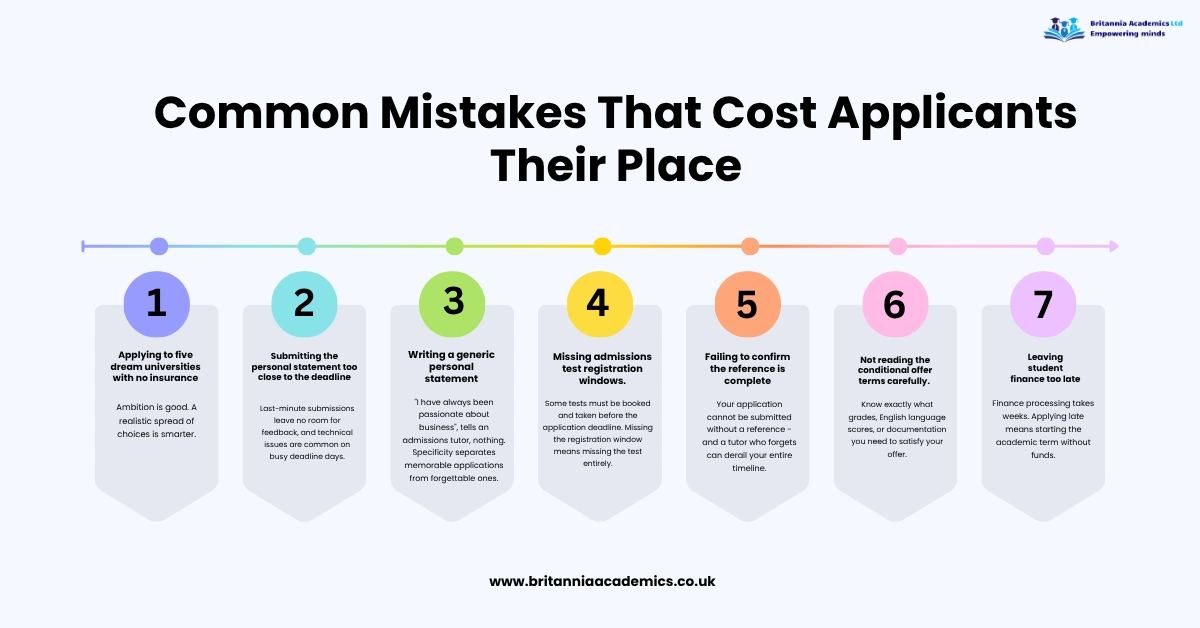
Infographic by Britannia Academics titled "Common Mistakes That Cost Applicants Their Place," showing a 7-step timeline of university application errors such as missing deadlines, generic personal statements, and late student finance.

Even strong candidates make avoidable errors.

These are the ones with the highest cost:

  • Applying to five dream universities with no insurance. Ambition is good. A realistic spread of choices is smarter.
  • Submitting the personal statement too close to the deadline. Last-minute submissions leave no room for feedback, and technical issues are common on busy deadline days.
  • Writing a generic personal statement. “I have always been passionate about business”, tells an admissions tutor, nothing. Specificity separates memorable applications from forgettable ones.
  • Missing admissions test registration windows. Some tests must be booked and taken before the application deadline. Missing the registration window means missing the test entirely.
  • Failing to confirm the reference is complete. Your application cannot be submitted without a reference – and a tutor who forgets can derail your entire timeline.
  • Not reading the conditional offer terms carefully. Know exactly what grades, English language scores, or documentation you need to satisfy your offer.
  • Leaving student finance too late. Finance processing takes weeks. Applying late means starting the academic term without funds.

Get Expert Support With Your UK University Application

Navigating the UK university application process is manageable – but it’s considerably less stressful with experienced guidance behind you.

Britannia Academics specialises in helping students secure places at top UK universities. Their services cover course shortlisting, personal statement writing and review, interview preparation, admissions test coaching, and scholarship guidance – tailored to each student’s profile, goals, and timeline.

Whether you’re beginning your research or mid-application and need expert review, Britannia Academics knows exactly what UK universities are looking for – because they’ve helped hundreds of students get in.

Contact Britannia Academics today and get the UK local expert support your application deserves.

Frequently Asked Questions

When should I apply to UK universities?

Most students apply between September and January. Competitive courses like Medicine and Oxbridge require applications by mid-October.

Yes, some universities accept alternatives, such as the Medium of Instruction (MOI), but many still require IELTS or an equivalent.
You can apply to up to five courses

A conditional offer means you must meet specific academic or English language requirements before your place is confirmed.

You can apply through Clearing, where universities offer remaining places to students who did not meet their conditions.
Yes, but it is now divided into three structured questions instead of one long essay.

Related Articles: