
Home Share On Social Media Top 10 Healthcare jobs in...
Read More
Quick Overview:
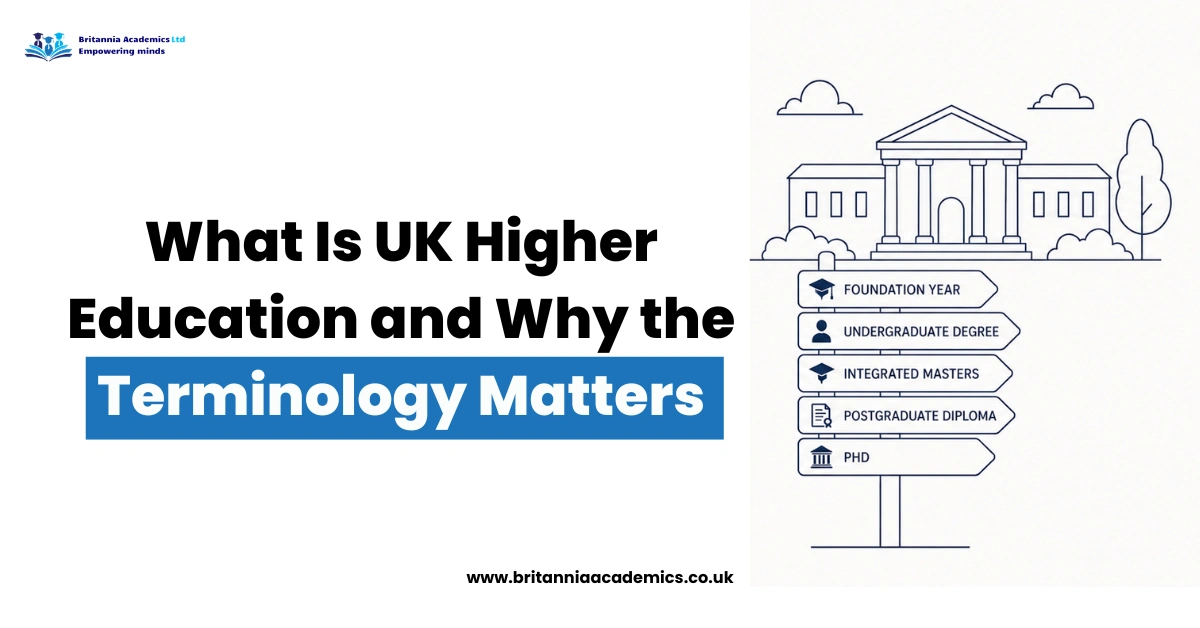
UK higher education refers to education delivered at universities and colleges after secondary school, typically starting at age 18. The sector uses a set of terms that are not self-evident – even students from the UK itself can find the language confusing when they first encounter it.
When you start researching UK universities, the qualification landscape quickly becomes confusing. Foundation years, undergraduate degrees, integrated masters, postgraduate diplomas – the terminology is not self-evident, and the UCAS system assumes you already know what you are applying for (Homeschool Start Guide, 2025).
This guide explains every major term in plain language, organised by category, so you can look up exactly what you need. If you are still at the stage of deciding whether university is right for you, the Britannia Academics guide to future trends in UK higher education for international students gives useful context on where the sector is heading in 2026.
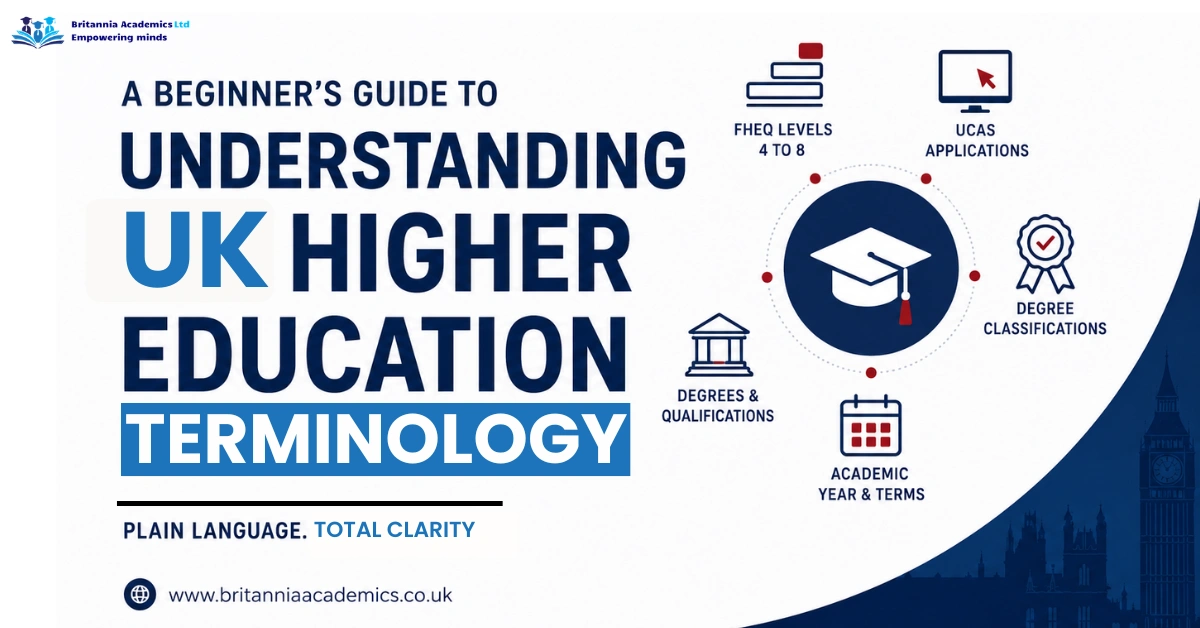
The Framework for Higher Education Qualifications (FHEQ) is the backbone of the UK system. It is a national framework that describes the academic level of higher education qualifications and helps answer questions such as how advanced a qualification is and whether a course is at the first year of university, the second year, or bachelor’s degree level (QAA, 2024).
UK higher education qualifications sit within this national framework, which assigns every award a level from 4 to 8. Understanding this framework matters because entry requirements, loan eligibility, and the value of each qualification all depend on the level (Homeschool Start Guide, 2025).
Here is what each level means in practice:
|
FHEQ Level
|
What It Corresponds To
|
|---|---|
|
Level 4
|
First year of an undergraduate degree / HNC
|
|
Level 5
|
Second year of an undergraduate degree / HND
|
|
Level 6
|
Final year of a bachelor's degree (honours)
|
|
Level 7
|
Master's degree / Postgraduate diploma
|
|
Level 8
|
Doctorate (PhD or equivalent)
|
FHEQ Level 4 is the first stage of higher education and is commonly compared with the first year of undergraduate study (QAA, 2024).
UCAS stands for the Universities and Colleges Admissions Service. It is the centralised system through which almost all undergraduate applications in the UK are submitted. You apply through UCAS, not directly to universities, and can typically apply to up to five courses in one application.
Every course on UCAS has its own entry code. The vast majority of UCAS applications target Level 6 – the bachelor’s degree – and this is the baseline expectation when a university says it requires “3 A-Levels” or a specific UCAS tariff score (UCAS, 2025).
UCAS Tariff points are a numerical value assigned to pre-university qualifications like A-Levels. For example, an A* at A-Level is worth 56 points. Universities publish minimum tariff requirements so applicants can compare entry thresholds across institutions.
Before you submit your application, it helps to know exactly what documents and information you will need. Read our guide on a complete checklist of documents needed to apply to a UK university, which covers every item you need to prepare.
Key UCAS stages to know:
To avoid the most costly application errors, read our breakdown of the top 5 mistakes to avoid during UK university applications before you submit.
Undergraduate Degrees
The bachelor’s degree is the standard UK undergraduate qualification. Most full-time programmes run for three years in England, Wales, and Northern Ireland, and four years in Scotland, where the honours degree includes a broader first year (Homeschool Start Guide, 2025).
BA (Bachelor of Arts) and BSc (Bachelor of Science) are the two most common titles. The difference is the subject area – arts and humanities lead to a BA, science and technical subjects to a BSc.
Honours degree (Hons) means the degree includes an assessed, specialist final year. Most bachelor’s degrees in the UK are honours degrees, shown as BA (Hons) or BSc (Hons) after your name.
In Scotland and some English universities, it is possible to exit after three years with an ordinary degree, or continue to a fourth year for the full honours degree (QAA, 2024).
Foundation year – a preparatory year offered before the start of a standard three-year degree, typically for students who do not yet meet the standard entry requirements. Foundation years are typically offered as four-year integrated programmes rather than standalone qualifications, and UCAS has separate entry codes for foundation year variants of most courses.
If you are applying as a mature student without traditional A-Level qualifications, entry routes differ. Our guide explains what entry requirements UK universities need for mature students, including Access to HE Diplomas and work-based routes.
Vocational Higher Education Qualifications
HNC (Higher National Certificate) – a vocationally focused higher education qualification offered in the UK, usually taking one year to complete and roughly equivalent to one year of university study.
HND (Higher National Diploma) – similar to the HNC but a two-year qualification, roughly equivalent to the first two years of a bachelor’s degree. Many HND graduates use it as a route into the second or third year of a degree programme.
Postgraduate Degrees
Master’s degree – a postgraduate qualification taken after a bachelor’s degree. Common postgraduate award titles include Master of Arts (MA), Master of Science (MSc), and Doctor of Philosophy (PhD) (QAA, 2024).
Common master’s types:
PhD (Doctor of Philosophy) – a research doctorate, usually three to four years full-time. It involves producing an original thesis on a research topic. A PhD sits at FHEQ Level 8 (QAA, 2024).
Integrated master’s – a degree that combines an undergraduate and master’s qualification into a single four or five-year programme, for example, MEng (Master of Engineering) or MPhys (Master of Physics).
When UK students complete a bachelor’s degree with honours, they receive one of four classifications. As defined by the QAA Qualifications Framework, UK universities classify undergraduate degrees into: First Class Honours (70% and above), Upper Second Class, known as a 2:1 (60-69%), Lower Second Class, known as a 2:2 (50-59%), and Third Class (40-49%) (QAA, 2024).
First class honours, or a “first”, is the highest level degree classification awarded by most UK course providers (UCAS, 2025).
A 2:1 is the most commonly required classification for postgraduate applications and graduate employer schemes. A 2:2 is still a full degree but may limit access to certain programmes or jobs.
The grade boundaries above are standard, but individual universities publish their own mark scales. All undergraduate modules at FHEQ levels 4, 5 and 6 are typically marked on a scale of 0-100, with 70-100 being First Class, 60-69 being Upper Second (2:1), 50-59 being Lower Second (2:2), 40-49 being Third Class, and 0-39 a fail (University of Warwick, 2022).
Modules
A module is a single unit of study within your degree – one course among many that make up your programme. At some universities, most modules are worth either 15 or 30 credits (UCL, 2022).
All modules are given a “credit” value to indicate the contribution towards your final grade. To progress to the next academic year, you will usually be required to accumulate a certain number of credits (Birmingham City University, 2024).
A standard full-time UK undergraduate year requires 120 credits. A standard module is normally valued at 20 credits, and a final dissertation or research project module is normally valued at 40 credits at the undergraduate level or 60 credits at the taught postgraduate level. This credit structure is set out in detail in the QAA Higher Education Credit Framework for England (QAA, 2021).
The Academic Year: Terms vs Semesters
UK universities split the academic year in one of two ways – either terms or semesters. The structure varies by institution.
A university semester, also called a “term” in some universities, is used to split the academic year to separate different blocks of teaching and assessments. On average, each semester lasts 12 weeks and consists of a mixture of lectures, tutorials, assessments, and holidays (Edge Hill University, 2025).
Universities that use terms divide the year into three parts: an Autumn Term beginning in September, a Spring Term beginning in January, and a Summer Term beginning in April, which is usually set aside for revision and examinations rather than timetabled teaching (UCL, 2022).
Types of Teaching Sessions:
|
Session Type
|
What It Is
|
|---|---|
|
Lecture
|
A large-group session, often 100+ students, delivered by a lecturer or professor
|
|
Seminar
|
A small group discussion session held to explore lecture content in more depth - Chevening's guide to UK university seminars explains exactly what to expect
|
|
Tutorial
|
A small-group or one-to-one session with a tutor for focused discussion or feedback
|
|
Lab
|
A practical session for science, engineering, or computing subjects
|
|
Workshop
|
A hands-on, task-based session in small groups
|
Lecturer – the staff member who delivers your modules and sets assessments. Their title may also be Senior Lecturer, Reader, or Professor, depending on seniority. The Chevening guide to UK lectures is a clear primer on what to expect in the lecture environment.
Personal Tutor – a Personal Tutor is assigned to you when you start university (Edge Hill University, 2025). This person is your academic point of contact for pastoral support, guidance on your studies, and progress reviews. They are not the same as a subject tutor.
Supervisor – the term used in postgraduate research contexts. Your supervisor guides your thesis or dissertation work.
Dean – the school Dean oversees the academic and administrative duties of their school or faculty, similar (though not entirely the same) to a head of subject at a high school (Birmingham City University, 2024).
Vice-Chancellor (VC) – the Vice-Chancellor oversees the university and is the person in charge, similar to a headteacher (Birmingham City University, 2024). You will rarely interact with the VC directly, but you will hear the title frequently.
If you are working with an admissions consultant to navigate these processes, it helps to understand what they can and cannot do on your behalf. Our article on how an education consultant can increase your UK admission chances explains this clearly.
A dissertation is an extended, independently researched piece of writing produced typically in the final year of a bachelor’s degree or throughout a master’s programme. It is the product of personal research and can vary from 5,000 words to 15,000 words for undergraduate and master’s students (Birmingham City University, 2024).
At most universities, you choose a topic within your subject area, submit a proposal, and are then assigned a supervisor. Students choose an area of study in conjunction with a tutor, who oversees the development of the dissertation, and at the beginning of the module, each student formulates a proposal which is submitted for review by academic staff (University of Kent, 2024).
The dissertation is typically the highest-credit single module on your degree and carries significant weight in your final classification.
Once you understand the terminology, the full application process becomes far easier to navigate. The Britannia Academics step-by-step guide to the UK university application process walks you through every stage from course research to accepting your offer.
FHEQ stands for the Framework for Higher Education Qualifications. It is the national system that assigns every UK higher education qualification a level from 4 to 8. It matters because it tells you how academically advanced a qualification is – Level 6 is a bachelor’s degree, Level 7 is a master’s, and Level 8 is a doctorate. Knowing the FHEQ level of a qualification helps you compare courses, understand entry requirements, and assess loan eligibility. The full framework is published by the QAA.
Both are valid UK honours degree classifications. A 2:1 (Upper Second Class) requires a final average of 60-69%, while a 2:2 (Lower Second Class) requires 50-59%. The practical difference matters most after graduation. Most UK graduate employer schemes and postgraduate programmes specify a minimum of a 2:1. These classifications are nationally defined by the QAA Qualifications Framework (QAA, 2024).
UCAS is the Universities and Colleges Admissions Service, the centralised application platform for UK undergraduate courses. Almost all full-time undergraduate courses require a UCAS application. Postgraduate applications are handled separately, either through a university’s own system or through a dedicated postgraduate admissions route.
Each module on your degree is assigned a credit value to reflect how much work it requires. A standard module is typically worth 20 credits. A full-time UK undergraduate year requires 120 credits. Accumulating the required credits across three years (360 in total for most degrees) is what allows you to graduate. The QAA credit framework sets out how credit is used across English higher education.
A dissertation is a long research-based piece of writing, usually produced in the final year of a bachelor’s degree or during a master’s programme. At undergraduate level it typically runs between 8,000 and 12,000 words, though lengths vary by institution and subject. You choose a topic, submit a proposal, receive a supervisor, and produce the work independently over several months.
Home Share On Social Media Top 10 Healthcare jobs in...
Read MoreHome Share On Social Media 13 Best Highest-Paying Entry-level Jobs...
Read MoreThe most employable UK degrees for international students in 2027...
Read MoreQuick Overview: UK higher education has its own set of...
Read More