Quick Overview: UK higher education has its own set of...
Read More

Mature students in the UK typically need Level 3 qualifications, such as an Access to HE Diploma or BTEC, or relevant work experience to enter university. Most universities do not require A-levels for mature applicants and assess candidates based on a combination of academic readiness, experience, and personal statement.
If you finished school years ago and you’re now thinking about going to university, you might feel like the door has closed. It hasn’t.
Every year, thousands of people in their 20s, 30s, 40s, and beyond start a degree in the UK. According to HESA (the Higher Education Statistics Agency), students aged 30 and over now make up around 15% of all first-degree learners in the UK – a figure that has grown steadily over the past five years. And that’s just the over-30s. Add in everyone between 21 and 29 returning to education, and the number is far bigger.
The good news is that UK universities don’t assess mature students the same way they assess 18-year-olds fresh out of sixth form. They look at the whole picture – your experience, your recent study, your reasons for applying, and your potential. A-levels are just one route in, and for most mature applicants, they’re not the most relevant one.
This guide explains exactly what UK universities look for when a mature student applies, what qualifications are accepted, and how to put together the strongest possible application.

In the UK, you are officially a mature student if you are 21 years old or over at the start of your undergraduate course. For postgraduate study, the threshold is usually 25 or over.
This age distinction matters because universities treat mature applicants differently from school leavers. They recognise that adults return to education through different paths, and they adjust what they look for in an application accordingly.
According to HESA’s 2023/24 student statistics, around 2.9 million students were enrolled in UK higher education institutions that year. A significant portion of those were mature learners – people balancing study with jobs, families, and other responsibilities.
Some universities also use the term “adult returner” for applicants who left education before getting the qualifications typically needed for a degree. If you fall into this category, many universities have specific admissions policies that make it easier to apply with alternative qualifications or relevant experience.
There is no maximum age limit for applying to a university in the UK. People in their 50s and 60s start degrees every year.

No – A-levels are not required. They are one route in, but they are far from the only one.
Most UK universities are very clear about this. The UK government’s official guidance on mature student university funding states that you can study at university as a mature student even if you do not have traditional qualifications, and that some universities will accept professional qualifications or relevant work experience instead.
That said, universities do want to see that you can handle degree-level study. The question is just how you show that.
Here are the qualifications UK universities commonly accept from mature applicants:
One important thing to note: different universities set their own policies. A post-1992 university (such as a former polytechnic) may be more flexible than a Russell Group institution.
Each year, students in the UK apply for over 450 different qualifications. If what you have isn’t listed on a university’s website, it’s always worth calling their admissions team directly. Many will accept more than they publicly advertise – and working with a UK education consultant can help you identify which institutions are most likely to welcome your specific background.
Work experience can be one of the most valuable parts of a mature student’s application – but how much weight it carries depends on the university and the course.
For most institutions, work experience does not entirely replace academic qualifications. What it does is strengthen your application by showing:
Which types of experience count?
How to present your experience:
In healthcare, nursing, social work, education, and law, as well as in voluntary experience, work is often considered essential rather than optional. If you’re heading towards one of these fields, explore the Health & Social Care courses or Law courses available through Britannia Academics’ partner institutions.
Here’s what you need to know:
What it is: A full Level 3 qualification (the same level as A-levels), regulated by the Quality Assurance Agency for Higher Education (QAA). Every Access to HE Diploma is awarded by a licensed body, an Access Validating Agency (AVA).
How it works: The Diploma is worth 60 credits. Of those, 45 credits must come from graded, academic units at Level 3 – the parts that universities look at most closely. The remaining 15 credits are ungraded and usually cover study skills.
How long it takes: Usually one year full-time at a further education (FE) college, or two years part-time. Many colleges now also offer online and blended versions.
What subjects are available: There are pathways for almost every degree area, including:
Who accepts it: Almost every UK university accepts the Access to HE Diploma. QAA statistics show that Access students who achieve their Diploma and progress to university perform comparably to those with other Level 3 qualifications – with 25% of Access to HE students going on to achieve a first-class degree, compared to 26% for those with traditional A-levels.
The diploma also has a strong track record for widening access. QAA data shows that 29% of Access to HE students entering higher education are from ethnic minority backgrounds, compared to 24% of those with other Level 3 qualifications. And 26% have a disability, compared to 15% of other Level 3 applicants.
Grade requirements: These vary by course. A humanities degree at a mid-ranking university might require a mix of Merits and Passes. A competitive medical or nursing programme may require Distinctions across the board. Always check the specific entry requirements for the course you’re targeting.
This is one of the most common questions – and the honest answer is: it depends.
No blanket rule that mature students automatically get lower entry requirements. What there is is a different approach to how your application is read.
Many universities – particularly post-1992 institutions with a strong focus on widening participation – will offer greater flexibility to mature applicants.
This is especially true if:
However, at Russell Group and other highly selective universities, the core academic requirements are largely fixed – regardless of age. You will still need to demonstrate strong academic ability, often through recent study or competitive entry tests.
For high-demand courses like medicine, dentistry, and veterinary science, entry requirements are set by the course itself and are not routinely lowered for mature applicants. You would still need to pass the required admissions tests (such as the UCAT for medicine) and meet the academic criteria.
The key takeaway: being a mature student signals that you are motivated and focused. It opens up conversations with admissions teams. But it doesn’t mean the bar is simply moved. If you’re unsure how your qualifications stack up, Britannia Academics’ university application service can assess your profile and match you to the right institutions.
For mature applicants, the personal statement carries more weight than it does for a typical school leaver. It is often the deciding factor between two applicants who look similar on paper.
A strong, mature student’s personal statement should cover four things:
Common mistakes to avoid:
Tone: Write like a clear, confident adult. You don’t need to be formal to the point of stiffness, but this is not a casual letter.
Read it aloud – if it sounds like something you’d actually say to someone you respect, it’s working. Getting your personal statement right is one of the areas where professional support makes the biggest difference.
Some courses require all applicants – mature or not – to attend an interview or complete a test before receiving an offer. For mature students, this is an advantage: face-to-face or video conversations allow you to bring your experience to life in a way a statement can’t.
Courses that regularly include interviews:
Admissions tests you may need to sit:
What interviewers look for in mature applicants:
Prepare by reviewing your personal statement, reading recent news or publications in your field, and practising your answers with someone who’ll give honest feedback.
For most mature students, the funding picture is more positive than people expect.
Tuition Fee Loans: There is no upper age limit for Tuition Fee Loans in England. According to GOV.UK’s student finance eligibility guidance, whether you’re 22 or 62, you can apply for a loan to cover your tuition fees – as long as you’re studying your first undergraduate degree and meet the standard residency requirements. The loan goes directly to your university and is repaid through your salary only once you earn above the repayment threshold (£25,000 for Plan 5 loans from 2025/26 onwards).
Maintenance Loans: These help with living costs. They are available to most mature students, but there is an important restriction: if you are 60 or over on the first day of your first academic year, you are not eligible for a Maintenance Loan.
Additional grants available to mature students:
For a full breakdown of what you’re likely to qualify for, read the detailed guide on who is eligible for Student Finance England in 2026.
If your qualifications are older or limited, a foundation year is one of the most practical routes into university – and it’s underused by mature applicants. A foundation year is an extra year added before the start of your main degree. You study at the university itself, building subject knowledge and academic skills before officially beginning Year 1 of your course.
Why it works well for mature students:
What subjects offer foundation years:
Foundation years are available across a wide range of subjects, including science, engineering, business, humanities, social sciences, and some healthcare-adjacent courses. You won’t find them in medicine or law, but they exist in most other fields.
The cost:
Foundation years are funded through the standard student finance system in the same way as regular degree years. You apply for a Tuition Fee Loan and Maintenance Loan just as you would for any other year of study.
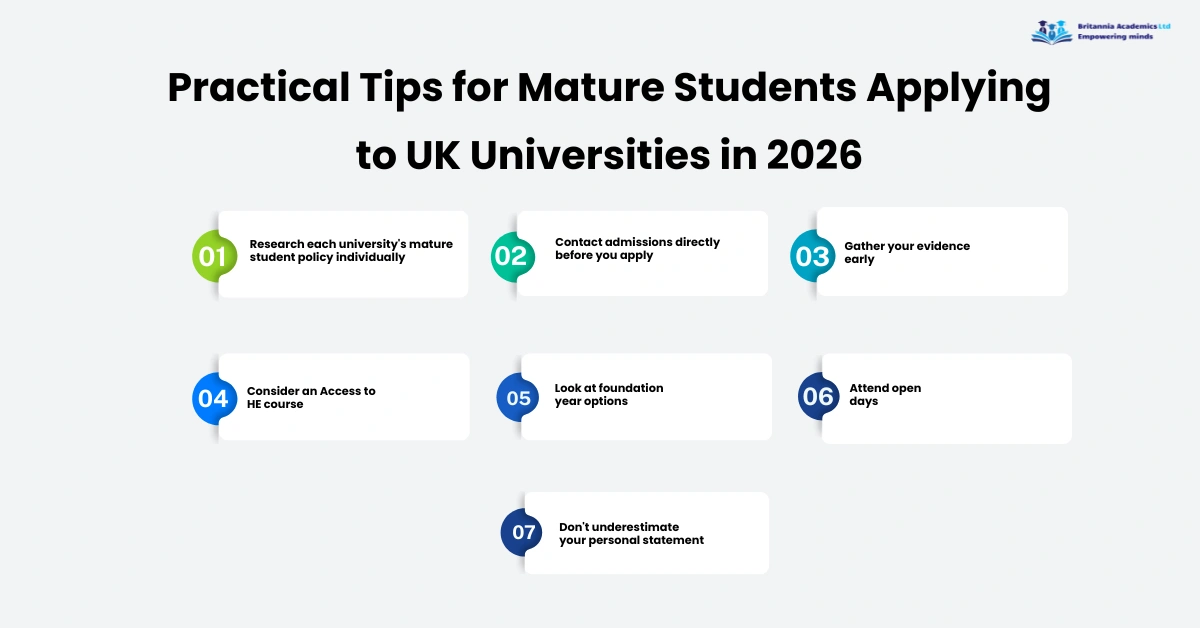
Before you apply, work through this checklist:
UK universities genuinely welcome mature students. This isn’t marketing language – it reflects what the data shows. Adults returning to education bring motivation, perspective, and real-world knowledge that enriches courses and benefits younger students too.
The path in looks different from the one an 18-year-old takes. Instead of A-levels, you may use the Access to HE Diploma, relevant work experience, a foundation year, or a combination of all three. Instead of predicted grades, your personal statement and life experience do much of the talking.
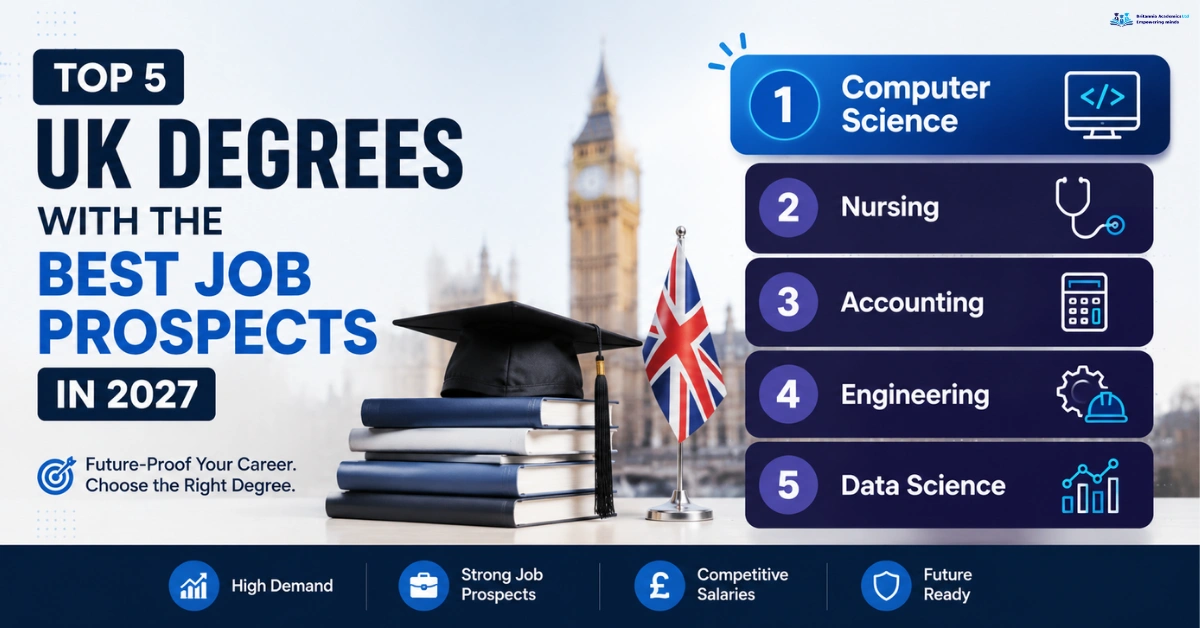
Before you choose a course, it’s also worth exploring the high-demand degrees in the UK job market for 2026 – a useful read if you want to make sure your degree leads to real employment opportunities on the other side.
The most important step is the simplest one: talk to someone who knows this process well. The team at Britannia Academics offers free, personalised student consultancy and can help you work out the right route, the right institutions, and the right time to apply.
Get in touch today and start your university journey with confidence.
In the UK, you are officially a mature student if you are 21 or older when you start your undergraduate course. For postgraduate study, most universities use 25 as the threshold. There is no upper age limit.
Yes, particularly for mature applicants navigating non-standard qualifications or career changes. A consultant helps match your background to the right institutions, strengthens your personal statement, and guides you through student finance – reducing mistakes and improving your chances considerably.
Quick Overview: UK higher education has its own set of...
Read MoreQuick Overview: UK higher education has its own set of...
Read MoreQuick Overview: UK higher education has its own set of...
Read MoreQuick Overview: UK higher education has its own set of...
Read More