
Home Share On Social Media Top 10 Healthcare jobs in...
Read More
Quick Overview:
To apply to a UK university, you need academic transcripts, a personal statement, a reference letter, and proof of identity. International students also need English language test scores and financial proof. The exact list varies slightly by course and institution, but the core set is consistent across all UCAS applications.
This checklist covers every document category – what it is, why it’s required, and what to watch out for when preparing it.
All undergraduate applications to UK universities go through UCAS (Universities and Colleges Admissions Service). You submit one application to up to five courses. Postgraduate applications are handled directly by each university, though some use centralised systems like UKPASS for specific programs.
Your documents support your application at two stages:
Knowing which documents are needed at each stage prevents last-minute delays.
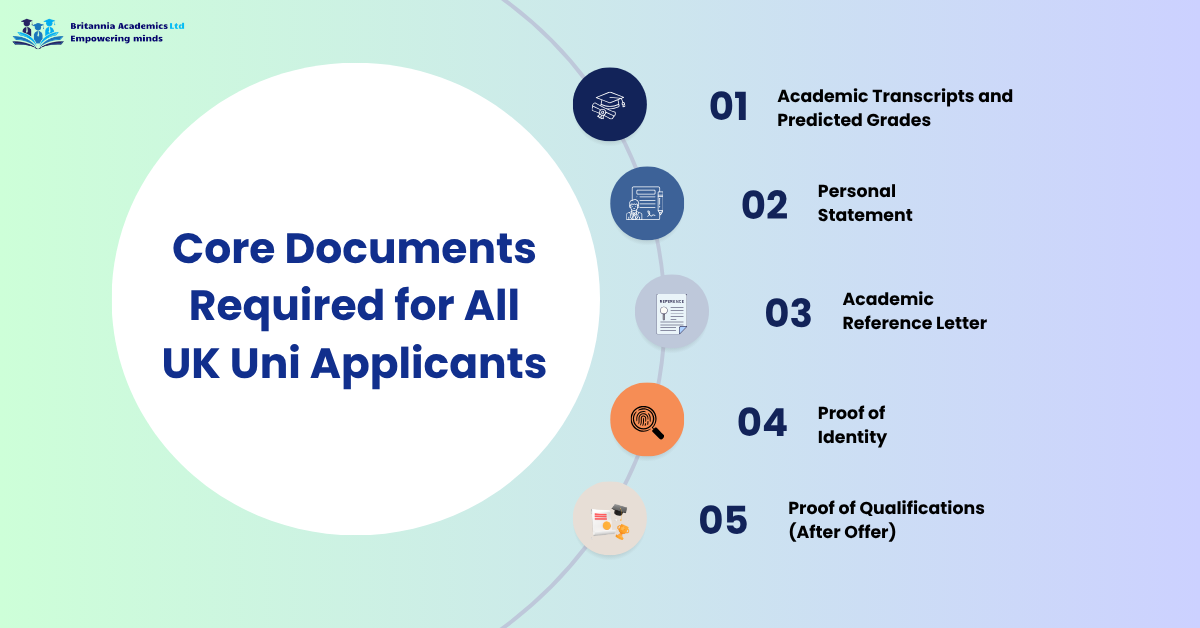
Transcripts are the official record of your grades from every school or college you have attended. For students still studying, universities accept predicted grades from a teacher or counsellor.
Your transcripts must cover:
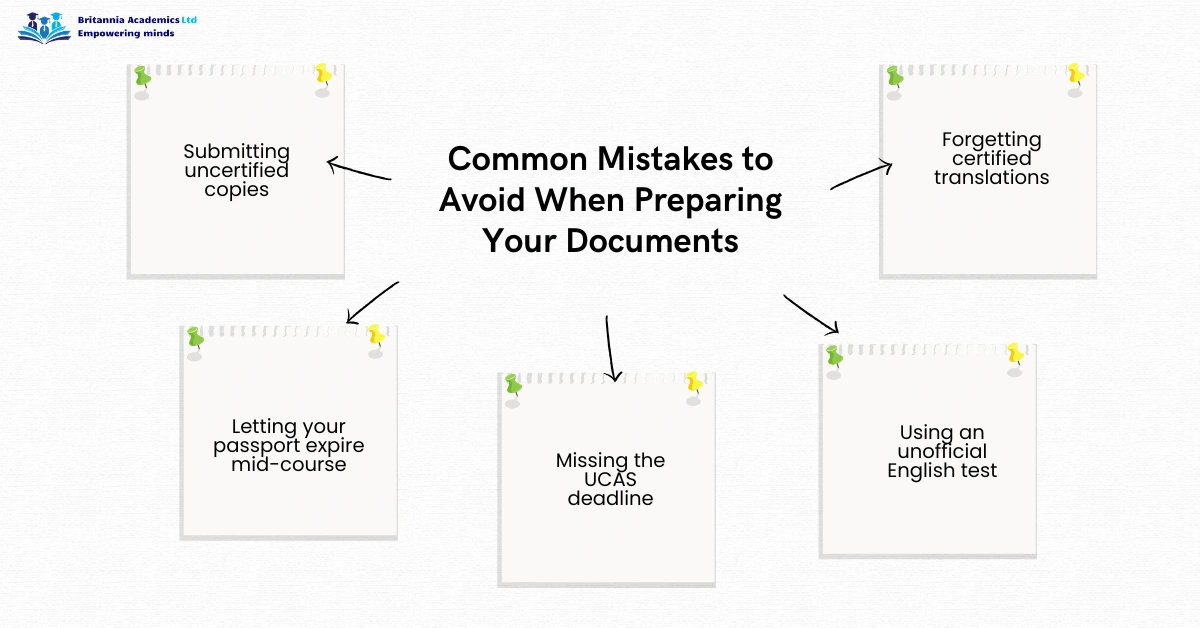
UCAS does not require you to upload scanned transcripts at the application stage – you enter grades manually. However, universities typically ask for certified copies after making an offer. “Certified” means a copy stamped or signed by the issuing institution or a recognised notary.
Watch out for: Unofficial transcripts printed from a student portal. Most universities will not accept these as final evidence.
The personal statement is a 4,000-character (47-line maximum) written statement explaining why you want to study your chosen subject. It is one of the most important parts of your UCAS application.
A strong personal statement covers:
UCAS introduced a new personal statement format in 2026 with structured questions instead of one open text box. Check the current UCAS guidance for the exact format before writing.
Watch out for: Writing the same personal statement for five very different courses. If your five choices span medicine and history, the statement will not be convincing for either.
UCAS requires one reference from a teacher, tutor, or school counsellor who knows your academic work. This is submitted directly by your referee through the UCAS system – you cannot submit it yourself.
The reference should confirm:
For mature students (aged 21 or over) who are not in education, a reference from an employer is acceptable.
Watch out for: References from family members or personal friends. UCAS explicitly prohibits these.
You need a valid form of ID to confirm who you are. For UK citizens, this is typically a passport or birth certificate. For international students, a valid passport is required throughout the application and enrollment process.
Your passport must:
Watch out for: Name discrepancies. If your passport uses a different version of your name than your application (for example, a middle name included in one but not the other), flag this with the university admissions team early.
Once you receive a conditional or unconditional offer, universities ask for official proof of the qualifications you listed.
This means:
Watch out for: Waiting until August (results day) to gather these. Contact your school well in advance for certified copies, especially if you graduated several years ago.
If you are applying from outside the UK, you need several documents beyond the standard list.
Most UK universities require proof of English proficiency for applicants whose first language is not English. The accepted tests and minimum scores vary by institution and course, but the most widely accepted options are:
|
Test
|
Accepted by
|
Typical Minimum Score
|
|---|---|---|
|
IELTS Academic
|
Almost all UK universities
|
6.0-7.0 overall
|
|
TOEFL iBT
|
Most universities
|
80-100 overall
|
|
Pearson PTE Academic
|
Many universities
|
51-65
|
|
Cambridge C1/C2
|
Many universities
|
Grade B or A
|
|
Duolingo English Test
|
Selected universities
|
100-120
|
Check the specific requirements for your course, not just the institution’s average. Medical and law programs typically set higher thresholds than others.
Some universities waive the English test requirement if you completed your previous qualification (A-Levels, IB, bachelor’s degree) in English. Confirm this directly with the admissions office before assuming you qualify for an exemption.
International students on a Student visa must show they can afford tuition fees and living costs before a Confirmation of Acceptance for Studies (CAS) is issued. This evidence is not submitted with your initial UCAS application – it is required once you have an unconditional offer and are applying for your visa.
Acceptable financial evidence includes:
Watch out for: Bank statements older than 28 days at the time of your visa application. Even if the balance is sufficient, outdated statements are rejected.
For your Student visa application (Tier 4), you need:
Some courses require materials that standard applicants do not need.
These courses are among the most competitive in the UK and typically require:
Many law programs require an LNAT (Law National Aptitude Test) score. The LNAT is required by around 11 UK universities, including Oxford, UCL, and Durham (LNAT Consortium, 2025). Register and sit the test before the UCAS deadline for your target universities.
These courses require a portfolio of creative work. Submission methods vary by university – some ask for a digital portfolio through their own portal, others request physical work at the interview. Check each university’s portfolio requirements individually.
Music applications typically require an audition, either in person or by recorded submission. Some conservatoires operate their own application systems outside UCAS.
Standard postgraduate documents:
Research programs (PhD and MRes) also typically require:
Some competitive postgraduate programs – MBA courses in particular – also ask for GMAT or GRE scores, a second reference from an employer, and evidence of work experience.
|
Document
|
Who Submits It
|
Required By
|
|---|---|---|
|
Application form
|
Applicant
|
All applicants
|
|
Academic transcripts/certificates
|
Applicant (uploaded or by post)
|
All applicants
|
|
Predicted grades letter
|
School / teacher
|
Current students only
|
|
Personal statement (650 words)
|
Applicant (in UCAS form)
|
All applicants
|
|
Academic reference letter
|
Referee (via UCAS)
|
All applicants
|
|
English language test results (IELTS etc.)
|
Applicants
|
International students
|
|
Valid passport copy
|
Applicant
|
International students
|
|
Financial evidence / bank statement
|
Applicant or sponsor
|
International students (visa stage)
|
|
Credential evaluation (Ecctis)
|
Applicant
|
Where required by university
|
|
UCAT / BMAT score
|
Test provider (shared directly)
|
Medicine, dentistry, vet science
|
|
LNAT score
|
Test provider (shared directly)
|
Law at specific universities
|
|
Portfolio
|
Applicant
|
Art, design, architecture
|
|
Written work samples
|
Applicant
|
Oxbridge humanities courses
|
|
Admissions test results (MAT, TSA, etc.)
|
Applicant / test provider
|
Oxbridge and select universities
|
|
DBS check
|
Applicant (arranged by university)
|
Teaching, nursing, social work
|
|
CAS number
|
University
|
International students (visa only)
|
Document errors are one of the most common reasons UK university applications are delayed or rejected. If you want someone to check your checklist, review your documents, and guide you through each stage of the process, Britannia Academics offers free, expert consultancy for both UK and international students.
Our team handles everything from document preparation and personal statement review to Student visa support and university selection. If you are applying for the first time, working with a specialist saves time and reduces the risk of avoidable mistakes.
Book a free consultation with Britannia Academics – no fees, no commitment.
The core documents are academic transcripts, a personal statement, one academic reference letter, and proof of identity. International students also need English language test scores (IELTS or equivalent) and financial evidence for their Student visa application.
No. At the UCAS application stage, you enter your grades and qualifications manually. Original or certified documents are only requested after you receive an offer, usually to confirm your place before enrollment.
Most UK universities accept IELTS Academic, TOEFL iBT, Pearson PTE Academic, and Cambridge C1/C2 qualifications. Minimum required scores vary by course. Some universities accept the Duolingo English Test for selected programs.
Financial evidence is not part of the initial UCAS application. You submit it after receiving an unconditional offer when applying for your Student visa through the UK Visas and Immigration service.
No. Admissions tests are required only for specific courses. Medicine requires UCAT (and sometimes BMAT), law requires LNAT at some universities, and some graduate programs require GMAT or GRE. Check the entry requirements for each course individually on the university website.
A certified document is a copy that has been verified as a true copy of the original. Your school, college, or university can certify copies with an official stamp and signature. Alternatively, a solicitor or notary public can certify documents.
Some universities waive the English test requirement if your previous qualification was taught and examined in English. This exemption is not automatic – you must confirm eligibility with the admissions office of each university you are applying to.
Home Share On Social Media Top 10 Healthcare jobs in...
Read MoreHome Share On Social Media 13 Best Highest-Paying Entry-level Jobs...
Read MoreThe most employable UK degrees for international students in 2027...
Read MoreQuick Overview: UK higher education has its own set of...
Read More