Britannia Academics

This feature image of How to write a personal statement for health and social care

Share On Social Media

How to Write a Personal Statement For a Health and Social Care Degree

Your personal statement is the one place in your university application where you get to speak for yourself. Grades and references matter – but this is where you explain, in your own words, why you want to study health and social care. Admissions teams read thousands of applications every year. Most applicants meet the grade requirements. So what makes one student stand out over another? Almost always, it comes down to the personal statement.
Health and social care degrees – nursing, social work, occupational therapy, and paramedic science – are some of the most competitive courses in the UK. Universities are not just picking students – they are selecting future carers who will work with vulnerable people.
This guide breaks down every section of a strong personal statement in plain, simple language. Whether you are writing your first draft or fixing a version that is not quite working, you will find exactly what to do here.

What Universities Look for in Your Personal Statement

Image Featuring What Universities Look for in Your Personal Statement

Admissions tutors for health and social care programmes are experienced professionals. Many have worked in the field themselves. They spot vague, copied-sounding language very quickly. Here is what they actually want to see:

  • Real passion – shown through experience, not just words
  • Understanding of the health and social care sector
  • Evidence of key skills like communication, empathy, and teamwork
  • Awareness of ethical responsibilities – safeguarding and dignity in care
  • Academic readiness – proof you can handle degree-level study

The key word in all of these is evidence. Saying you are passionate or caring means nothing without a real example to back it up.
The 5-Part Structure of a Strong Personal Statement

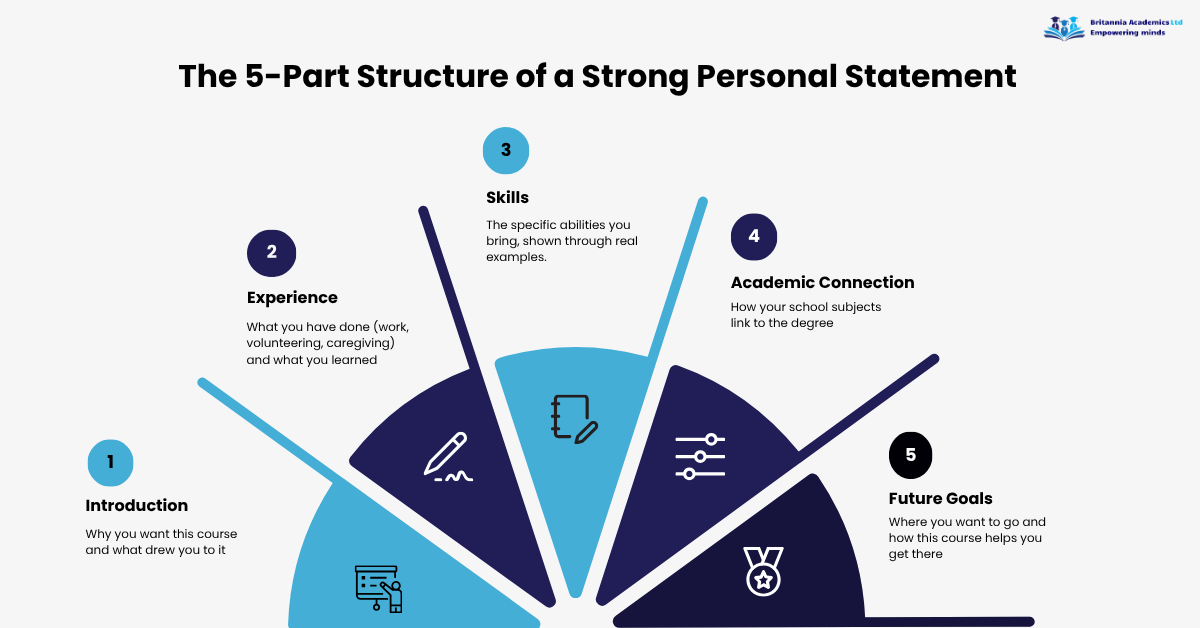
An infographic titled "The 5-Part Structure of a Strong Personal Statement" by Britannia Academics Ltd, illustrating five key sections: Introduction, Experience, Skills, Academic Connection, and Future Goals with descriptive icons.

Think of your personal statement like a short story with a beginning, middle, and end. It should have a clear, easy-to-follow flow. 

Here are the five parts every strong statement includes:

  1. Introduction – Why you want this course and what drew you to it
  2. Experience – What you have done (work, volunteering, caregiving) and what you learned
  3. Skills – The specific abilities you bring, shown through real examples
    Academic
  4. Connection – How your school subjects link to the degree
  5. Future Goals – Where you want to go and how this course helps you get there

UCAS allows your statement to be up to 4,000 characters. Aim to use at least 3,500. If you are unsure about common pitfalls before you start writing.

How to Write a Compelling Opening

Your first paragraph has one job: make the reader want to keep reading. The best openings are specific and personal. They describe a real moment – something you saw, felt, or experienced – that explains why you are drawn to this field.

What to avoid

These lines appear in so many applications that they have stopped meaning anything:

  • “I have always wanted to help people.”
  • “From a young age, I knew I wanted to work in healthcare.”
  • “Health and social care has always fascinated me.”
  • Opening with a dictionary definition of any word

None of these are technically wrong. They are just invisible. They do not say anything specific about you. Replace them with something only you could have written.

What to do instead

Describe a real moment that changed how you saw the profession. You may have helped care for a family member and noticed how much kindness mattered. You could have volunteered at a place and seen a skilled carer make a real difference. Start there. Then connect it to why you are applying now.

Showing Your Passion for Health & Social Care

Passion is not something you describe – it is something you show. Saying you are passionate about care means nothing on its own. Describing how you spent six months volunteering at a care home, or how learning about the NHS staffing crisis made you want to be part of the solution – that is something a tutor can work with.

Ask yourself these three questions when writing this section:

  • Why this field specifically – not just “working with people,” but what about health and social care draws you in?
  • Who or what influenced you – a family experience, a role model, something you read or watched?
  • What current issues in care do you know about – staffing shortages, social care funding, and integrated care systems?

You do not need to be an expert on these issues. But showing that you pay attention to them tells the university you are serious. Understanding things like what health and social care graduates earn and where the sector is heading also demonstrates genuine engagement with your future career.

Highlighting Work Experience and Volunteering

Work experience is the most important part of your personal statement. Most health and social care programmes expect to see it. It shows you know what the work really involves – and that you are committed enough to have gone and done it.

What counts as relevant experience

  • Care homes and residential settings
  • Hospitals (volunteering, patient transport, ward help)
  • Community and mental health services
  • Schools and education support roles
  • Hospices and end-of-life care settings
  • Looking after a family member at home
  • Disability support organisations or charities

If you are still looking for placements, the NHS volunteering page is a good starting point. Many local councils also list social care volunteering through GOV.UK community volunteering portals.

How to write about it – the right way

Do not just list what you did. Reflect on what it taught you. That reflection shows real learning.

Instead of:

“I volunteered at a care home where I helped residents with meals and activities.”

Try:

“During six months volunteering at a care home, I learned how much it matters to adapt the way you speak to each person. One resident with dementia responded much better to open conversation than to direct questions. Learning to read those cues changed how I think about person-centred care.”

The second version is specific, shows what you learned, and proves you can think critically – exactly what universities want.

Linking Your School Subjects to the Course

You do not need to list every subject you have studied. Pick the ones that connect directly to health and social care and explain what you actually learned from them.

Subjects that link well include:

  • Biology – gives you a foundation in how the body works, which underpins a lot of healthcare studies
  • Psychology – essential for understanding mental health, behaviour, and therapeutic approaches
  • Sociology – helps explain health inequalities and the social factors that affect well-being
  • Health and Social Care (A-level or BTEC) – directly relevant; mention specific units that shaped your thinking
  • English – important for the heavy amount of writing, recording, and communication the job involves

If you completed a project related to health or care, mention it.

Explaining Your Career Goals

Universities invest a lot in training health and social care graduates. They want to see that you have thought about what comes after the degree – not just that you plan to figure it out later.

You do not need a perfectly mapped-out career plan. But you should be able to say:

  • What area of care interests you most – mental health, elderly care, children, disability support, community work
  • Why does that area appeal to you specifically
  • How the degree will help you develop the skills and knowledge to get there

Not sure which career path fits you? The Britannia Academics career counselling service is designed to help students work through exactly this question.

Writing a Conclusion That Sticks

Your closing paragraph is not the place to summarise everything you have already said. It is your last chance to leave the reader with a clear sense of who you are.

A strong conclusion does three things:

  • Reinforces your commitment to the field without repeating yourself
  • Pulls together your key strengths in one or two tight sentences
  • Ends with confidence – not doubt, not a weak trailing sentence
  • Three to five sentences are plenty. End on a forward-looking note that connects your past experience to what you plan to do next.

Common Mistakes to Avoid

Even strong applicants can damage a good application with avoidable errors. Watch out for these:

  • Being too vague – if your statement could have been written by anyone, it needs more work
  • Listing without reflecting – describe what you did, but always explain what it taught you
  • Overusing buzzwords – words like “passionate” and “dedicated” need real examples behind them
  • Grammar and spelling mistakes – care professionals write records and reports throughout their careers
  • Making things up or exaggerating – it often unravels at the interview
  • No clear structure – jumping between topics without transitions makes the statement hard to follow

Quick Tips to Make Your Statement Stand Out

  1. Use active voice – “I observed,” not “It was observed by me”
  2. Keep sentences short and clear – if you need to read a sentence twice, simplify it
  3. Ask a teacher or mentor to review your draft – outside eyes catch things you miss
  4. Read it aloud – you will immediately hear where it sounds clunky or repetitive
  5. Leave at least 24 hours between drafts – fresh eyes spot more
  6. Write specifically for health and social care – do not hedge toward other subjects

Final Checklist Before You Submit

Go through each of these before you send your application. If the answer to any question is no, your statement needs another pass.

  • Have you clearly explained why you want to study health and social care?
  • Is every skill backed up by a real, specific example?
  • Does your statement have a clear structure – intro, experience, skills, academics, goals, conclusion?
  • Have you reflected on your experiences rather than just described them?
  • Have you shown some awareness of real issues in the health and social care sector?
  • Have you proofread for spelling, grammar, and flow?
  • Have you asked a teacher or mentor to read it?
  • Does it sound like you – not a template?
  • Have you avoided clichés and vague statements throughout?
  • Is it within the allowed character and line limits?

Final Thoughts: Authenticity Matters More Than Perfection

Writing a strong personal statement takes time. It cannot be done well in one sitting. The best ones go through multiple drafts – each pass cutting the generic parts and replacing them with something more real.

The applicants who succeed are not always the ones with the highest grades. They are the ones who can clearly and honestly show that they understand what this work involves, that they have engaged with it, and that they are ready to commit to the training a degree requires.

Start early. Write a messy first draft. Get feedback. Revise. Read it aloud. Revise again. If you want expert support through the whole application process, Britannia Academics offers a dedicated university application service and one-to-one student consultancy to help you put your best application forward.

Most importantly – be honest. Admissions tutors read hundreds of statements. They can tell when something is genuine. If your statement honestly reflects who you are, what you have done, and why this matters to you, you have already done the most important thing right.

Whether you are writing your very first draft or polishing your fifth, Britannia Academics will help you put your best self on the page – at absolutely no cost to you.

👉 Claim your free personal statement review from Britannia Academics today.

Frequently Asked Questions

What should I write in a health and social care personal statement?

Write about your motivation for the field, relevant work or volunteering experience, key skills like communication and empathy, academic subjects that connect to the course, and your career goals – all backed by specific real examples.

UCAS allows up to 4,000 characters or 47 lines. Aim for at least 3,500 characters to show depth. Use every word purposefully – avoid padding, but do not leave significant space unused.

Yes – most universities expect it. Care home volunteering, NHS roles, community support, or caring for a family member all count. Reflect on what each experience taught you, not just what you did.

Focus on communication, empathy, teamwork, problem-solving, and time management. A brief real example must support each skill – simply listing them without evidence adds no value to your application.
Close with three to five confident sentences that reinforce your commitment, briefly summarise your strongest qualities, and look forward to the degree. Avoid repeating earlier points or ending with a weak, trailing sentence.

Related Articles: