Britannia Academics

Can UK universities detect ChatGPT AI-generated content? Student guide featuring a laptop, AI detection graphics, and a UK university campus.

Share On Social Media

Can UK Universities Detect ChatGPT? Students Must Know

Yes, UK universities can sometimes detect the use of ChatGPT in student assignments, but they cannot identify every piece of AI-written text. Universities may use AI detection tools, plagiarism checkers, and other checks to identify potential AI misuse. However, these tools can make mistakes, so their results should not be treated as clear proof on their own.

Artificial intelligence (AI) is becoming more common in education. Many UK students now wonder whether universities can tell if an essay, dissertation, or assignment was written using ChatGPT. Alongside understanding detection methods, students can explore these AI study tools for UK students to learn how AI can support revision, research, and productivity.

The answer depends on how the tool was used, the university’s rules, and the evidence available.
Understanding these rules is important because using AI without permission may trigger an academic misconduct investigation. This guide explains how universities detect AI use, how accurate AI detectors are, what happens if a student is suspected of using AI, and how to use ChatGPT responsibly while studying in the UK.

How Do UK Universities Detect ChatGPT Use?

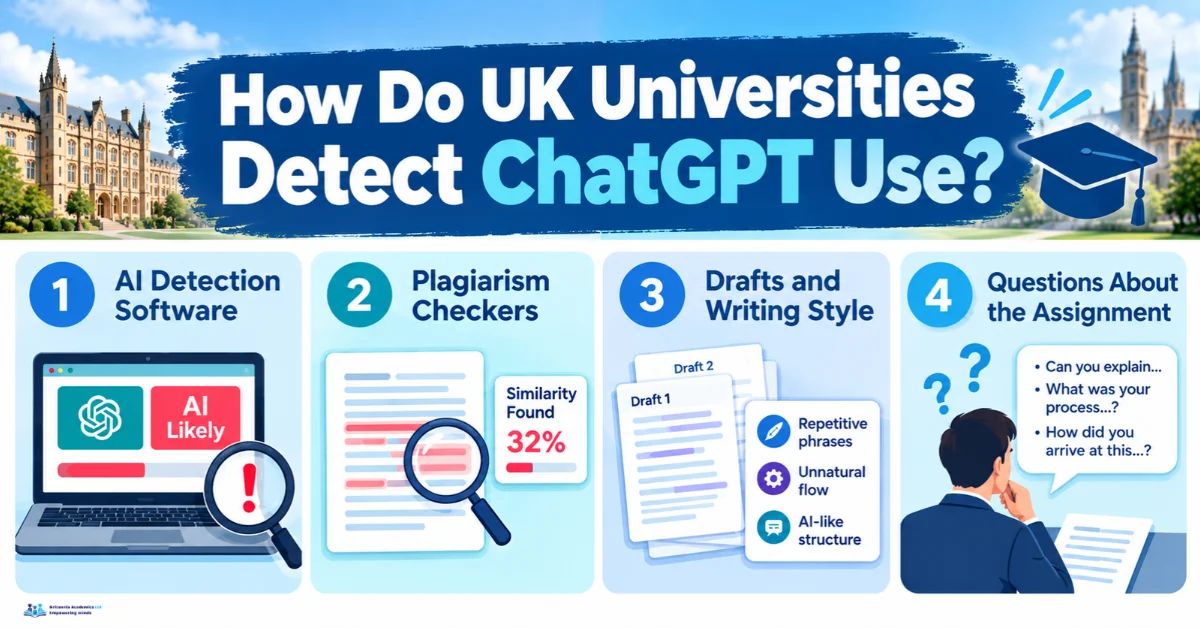
How do UK universities detect ChatGPT use? Infographic explaining AI detection software, plagiarism checkers, writing style analysis, and assignment questions.
Universities may use several methods to investigate suspected AI use.

1. AI Detection Software

AI detectors analyse patterns in written text and estimate whether AI may have generated it.

However, they can:

  • Flag human-written text incorrectly.
  • Miss AI-generated content.
  • Produce results that need further investigation.

According to Turnitin’s official AI Writing Report guidance, AI detection has limitations and requires careful review.

2. Plagiarism Checkers

Plagiarism checkers look for text that matches existing sources, such as websites, books, and journal articles.

Remember the difference:

  • Plagiarism detection identifies matching text.
  • AI detection estimates whether text may have been generated by AI.

A high similarity score does not automatically prove plagiarism, and a low score does not prove that AI was never used.

3. Drafts and Writing Style

Lecturers may review assignment drafts, research notes, and document version history. They may also compare a student’s current work with previous assignments.

Keeping genuine drafts and research notes can help students explain how their work developed.

4. Questions About the Assignment

A lecturer may ask a student to explain their argument, research methods, or sources.

Students should understand the work they submit. However, struggling to answer a question under pressure is not, by itself, proof of academic misconduct.

Can you get in trouble for using ChatGPT?

Yes, if your university or assessment does not allow it. Unauthorised AI use is generally treated as academic misconduct, and the consequences can range from a reduced mark to a failed module or, in serious cases, further penalties.

An Edinburgh Napier survey of more than 6,600 students across seven UK universities found that 32% admitted some unpermitted AI use in assessments. Universities in Scotland alone have reported hundreds of confirmed cases.

Policies are not uniform. Research covering 163 UK universities found that more than 40% had no publicly accessible AI policy, and a HEPI study found that 42% of students were less likely to use AI for fear of being falsely accused. That inconsistency means you’re responsible for checking the rules for each assessment.

What counts as acceptable AI use?

It depends on the university, department, and assessment brief. Common categories include:

  • Not permitted: AI is not to be used at all. Submitting AI-generated text would be misconduct.
  • Limited use: AI may be used for tasks such as brainstorming, outlining or checking grammar, but not for writing the submitted work.
  • Permitted with declaration: AI use is allowed, but you must state how you used it.
  • Integrated: AI is part of the task, and you are assessed on how you use it.

If the brief is unclear, ask your module leader in writing and keep the reply.

What should you do if you are accused of using AI?

If your own work is flagged, stay calm. A detection score is not evidence of misconduct on its own.

  • Do not panic or admit to something you did not do. Ask to see exactly what evidence has been raised.
  • Gather your process evidence. Drafts, notes, browser history, version history, and reading lists all help.
  • Prepare to explain your work. Be ready to talk through your argument and sources in your own words.
  • Contact your students’ union advice service. They can support you through the misconduct procedure.
  • Read your university’s academic misconduct procedure and note the appeal routes.

How to use AI safely and honestly

How to use AI safely and honestly for university studies with a student using a laptop
  • Read your assessment brief and your university’s AI policy before you start.
  • Declare any permitted AI use clearly.
  • Write in your own words and keep your drafts and notes.
  • Verify every source.
  • AI tools can invent references that look real.
  • Use AI, where allowed, to help you learn rather than to produce the submission.

Conclusion

UK universities can sometimes detect suspected ChatGPT use, but AI detection is not completely accurate. Universities may review assignments, check sources, examine drafts, and ask students to explain their work.

The best approach is not to focus on avoiding detection. Instead, understand your university’s rules, use AI responsibly, verify your sources, and submit work that demonstrates your own knowledge.

Before submitting your next assignment, check your university’s AI policy and assessment instructions. This will help you protect your academic integrity and use AI as a learning tool.

Frequently Asked Questions

Can UK universities detect ChatGPT?

Sometimes, but not reliably with software alone. They use AI detection tools plus human checks such as style comparison, reference checking, and viva questioning. None is conclusive, and some universities have switched AI detection software off (Phrasly, 2026).

Turnitin’s AI writing report estimates how much of a submission may be AI-generated. Turnitin reports a 1% false-positive rate (University of Huddersfield, 2024), but some researchers argue that accurate detection is impossible, so the score is an estimate rather than proof.

Turnitin is the best known. Some universities use Copyleaks, and individual lecturers may use GPTZero, Grammarly, Originality.ai, Winston AI, or Pangram (Phrasly, 2026). Which tool applies to you depends on your university and lecturer.

Turnitin says it can flag text rewritten by tools such as Grammarly or QuillBot (University of Huddersfield, 2024). Since 27 August 2025, it also targets humanising tools (University of Bristol, 2025). Rewriting AI output is still misconduct where AI is not allowed.

It depends on the assessment. Fewer students now report bans, and 38% said their institution provides generative AI tools, up from 9% in 2024 (Advance HE, 2026). Students remain unsure what is acceptable, so read the assessment brief and ask your module leader if unsure.

Related Articles: