Home Share On Social Media How Many Universities Can You...
Read More

You can apply to up to five courses through UCAS for 2027 entry, and one £34.50 fee covers all of them. The five choices can be at five or fewer UK universities. Only four of the five may be in medicine, dentistry, veterinary medicine, or veterinary science. You also cannot apply to both Oxford and Cambridge in the same cycle.
Quick Summary:
Always check the official UCAS application deadlines and the deadline for your individual course.
UCAS (the Universities and Colleges Admissions Service) manages almost all full-time undergraduate applications in the UK. Every applicant gets one application with up to five choices. A “choice” is one course at one university.
A few important points:
Yes. You can use more than one of your five choices for different courses at the same university, provided the institution accepts applications for those courses through UCAS.
For example, you might apply for Business Management and Marketing at one university, then use your remaining choices for courses at other institutions.
Before using multiple choices at the same university, compare course modules, entry requirements, assessment methods, and career opportunities. Different course titles do not always mean significantly different programs.
Although five is the standard limit, some applicants must follow additional rules.
|
Application type
|
Rule for 2027 entry
|
|---|---|
|
Standard undergraduate application
|
Up to five course choices
|
|
Medicine, dentistry, veterinary medicine, and veterinary science
|
A maximum of four choices across these subjects
|
|
Oxford and Cambridge
|
Normally, apply to only one of the two
|
|
UCAS Conservatoires
|
Up to six choices through the conservatoire application route
|
Check the official UCAS application guidance before submitting an application, particularly if you are applying for a specialist or graduate-entry course.
Your deadline depends on the course and institution you choose. Submitting an application by the relevant equal-consideration deadline means the university or college must consider it on an equal footing with other applications received by that deadline.
The main dates for 2027 entry are:
|
Date
|
What happens
|
|---|---|
|
15 October 2026, 18:00 UK time
|
Equal-consideration deadline for Oxford, Cambridge, and most medicine, dentistry, and veterinary courses
|
|
13 January 2027, 18:00 UK time
|
The equal consideration deadline for most other undergraduate courses
|
|
25 February 2027
|
UCAS Extra opens for eligible applicants
|
|
30 June 2027, 18:00 UK time
|
Applications received by this deadline are sent to universities and colleges; later applications enter Clearing
|
Important: These dates relate to the standard 2027 undergraduate application cycle. Some courses have different deadlines. Always check the course listing and official UCAS dates and deadlines.
Missing the 13 January equal-consideration deadline does not automatically mean you cannot apply to the university.
Universities and colleges may consider late applications if they still have places available, but they are not required to give them equal consideration with applications received by the deadline.
If you are applying late, contact the university or college to ask whether it is still accepting applications for your chosen course. This is particularly important for competitive courses with earlier deadlines.
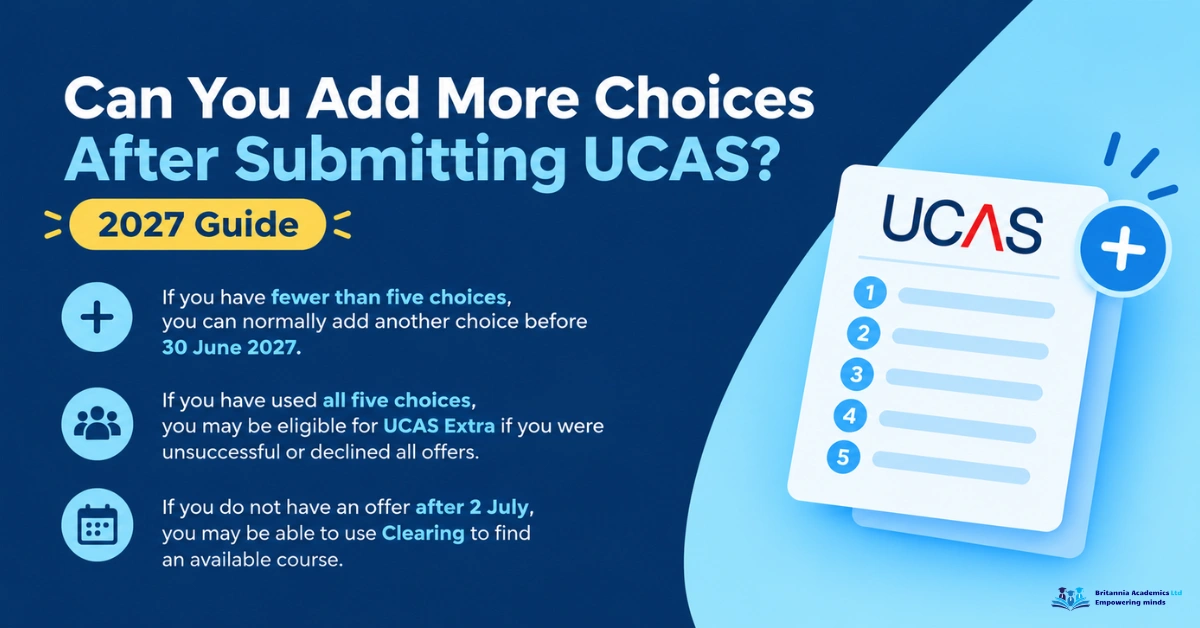
Yes, depending on how many choices you have used and the status of your application.
UCAS Extra runs from 25 February to 1 July 2027. It allows eligible applicants to apply to one course at a time. Check the official UCAS Extra guidance before using the service.

Using all five choices can give you more opportunities, but the aim should be to build a suitable shortlist rather than simply applying to as many universities as possible.
Identify the subject or career direction you want to pursue. Research course content, teaching methods, placement opportunities, and the qualifications required for your intended career.
Where possible, choose courses in related subjects so that your application clearly demonstrates your interest and preparation.
Check the entry requirements for every course. Consider predicted grades, required subjects, English-language qualifications, admissions tests, interviews, and any relevant experience.
Do not assume that two courses with similar titles have the same entry requirements.
One possible approach is to include:
This is a planning framework, not a guarantee of admission. A course with lower entry requirements is not automatically a safe option, because universities consider different factors when making decisions.
For the 2027 entry, UCAS uses three personal statement questions:
Your answers are considered together. Focus on relevant evidence, your motivation, the skills you have developed, and how your experience prepares you for the subject.
If you are applying for courses in very different fields, it may be harder to demonstrate a coherent interest across your choices. Consider whether your shortlist reflects a clear academic direction.
Read the official UCAS personal statement guidance for 2026 entry onwards for advice on the three-question format.
Before finalising your choices, confirm:
This final check can help you avoid using a choice on a course that does not match your interests or qualifications.
For the 2027 entry, you can apply to five undergraduate courses through UCAS for £34.50. Research your options, check deadlines and choose courses that match your goals.
Need help with your university application?
Get Free expert guidance from Britannia Academics and take the next step towards university.
No. UCAS does not allow applications to both in the same cycle, so you must choose one. Applying to either one still leaves you four choices at other universities.
No. You can apply to fewer than five, and the fee is still £34.50. Using all five gives you a better chance of receiving an offer, so most applicants fill every slot.
No. Universities cannot see the order or the other choices on your application. You rank your options later, when you select your firm and insurance choices.
You can apply to a maximum of four medicine, dentistry or veterinary courses. Your fifth choice must be a different subject, so many applicants use it for a related science degree.
Home Share On Social Media How Many Universities Can You...
Read MoreHome Share On Social Media Part-Time vs Full-Time Degree in...
Read MoreHome Share On Social Media Top 10 Healthcare jobs in...
Read MoreHome Share On Social Media 13 Best Highest-Paying Entry-level Jobs...
Read More
A full-time UK degree usually takes three years (four for most Scottish honours degrees) and treats study as your main commitment.
A part-time degree spreads the same qualification over a longer period, often four to six years, so you can keep working.
The award is at the same level. The real differences are speed, yearly cost, funding rules and how much of your week the course takes.

Vacancy rates have improved, but the NHS is far from fully staffed. According to NHS England Digital’s vacancy statistics, the NHS in England had a vacancy rate of 6.5% (97,475 posts) at 31 March 2026. Registered nursing, which includes midwives and health visitors, stood at 5.0% (21,643 vacancies), and medical staff at 4.5% (7,474 vacancies). All three were lower than a year earlier.
Three forces keep demand high heading into 2027:
|
No
|
Job
|
Typical NHS band
|
2026/27 pay (England)
|
Main entry route
|
|---|---|---|---|---|
|
1
|
Community/adult nurse
|
Band 5
|
£32,073–£39,043
|
Nursing degree or apprenticeship
|
|
2
|
Mental health nurse
|
Band 5
|
£32,073–£39,043
|
Mental health nursing degree
|
|
3
|
Healthcare support worker
|
Band 2–3
|
From £25,272 to £27,476
|
No degree needed
|
|
4
|
Diagnostic radiographer
|
Band 5
|
£32,073–£39,043
|
Radiography degree
|
Pay figures are Agenda for Change pay scales effective from 1 April 2026 for England, shown from entry to the top step point of the band. Doctors are paid under separate national scales, and social care pay is set by individual employers.
Entry pay is only the starting point. If you want to see how earnings can grow, this guide to the highest-paying careers in the UK after a Health & Social Care degree looks at where a qualification can lead over time.
Why in demand: Care is moving out of hospitals and into homes and neighbourhoods. The NHS Long Term Workforce Plan projected that the shortfall in community nurses will reach at least 37,000 full-time equivalents by 2036/37, up from 6,500 in 2021/22.
What they do: Provide clinical care in patients’ homes, GP practices and community clinics, including district nursing, wound care and long-term condition management.
How to get in: A nursing degree, a nursing degree apprenticeship, or a route from healthcare assistant to nursing associate to registered nurse.
Why in demand: The Long-Term Workforce Plan identified the current shortfall in mental health nursing as a particular concern, with the highest vacancy rates in inpatient services. It projected a total mental health nursing shortfall of 15,800 FTEs by 2036/37.
What they do: Assess, support, and treat people with conditions such as depression, psychosis, and anxiety across wards, crisis teams, and community services.
How to get in: A mental health nursing degree, then registration with the Nursing and Midwifery Council (NMC).
Why in demand: Among non-registered staff, healthcare support workers were projected to have the largest shortfall.
What they do: Help nurses and allied professionals with personal care, observations, and patient support.
How to get in: No degree is required. It is also a well-used stepping stone into nursing through apprenticeships.
Why in demand: Diagnostic expansion, including community diagnostic centres, needs more imaging staff. The Long-Term Workforce Plan lists diagnostic radiographers among the allied health professions where shortfalls are projected to grow the most. One industry source reports vacancy rates of around 13%, although this is not an official NHS figure.
What they do: Operate X-ray, CT, and MRI equipment to produce images used for diagnosis.
How to get in: An approved radiography degree, then HCPC registration.
Why in demand: Ultrasound demand is high across maternity, general diagnostics and musculoskeletal services. One career guide reports that sonographer vacancy rates are among the highest of any NHS allied health profession, so treat this as a reported trend rather than an official statistic.
What they do: Perform and interpret ultrasound scans for conditions ranging from pregnancy monitoring to tumour detection.
How to get in: Usually a radiography degree followed by a postgraduate qualification in ultrasound, typically reaching Band 7.
Why in demand: Primary care is under pressure. The Long-Term Workforce Plan projected a shortfall of 15,000 qualified GPs by 2036/37. The government has also committed to recruiting thousands more GPs as part of its 10-year workforce plan.
What they do: Diagnose and manage a wide range of conditions and coordinate ongoing patient care.
How to get in: A medical degree, foundation training, then GP speciality training.
Why in demand: Paramedics are named among the allied health professions where shortfalls are projected to grow the most. Roles are also expanding beyond ambulances into urgent care, GP practices, and community teams.
What they do: Provide emergency and urgent care, assess patients on scene, and decide on treatment or conveyance.
How to get in: A paramedic science degree or an approved apprenticeship, with HCPC registration.
Why in demand: OTs are also named among the allied health professions with sharply growing projected shortfalls. Their role in helping people live independently supports hospital discharge and community care.
What they do: Help people of all ages adapt to injury, illness or disability through practical support and adjustments to daily living.
How to get in: An approved OT degree or degree apprenticeship, with HCPC registrati
Why in demand: Pharmacists are increasingly working in GP practices, primary care networks, and community services, and the clinical role is expanding.
What they do: Review and optimise medicines, advise patients, and prescribe in some settings.
How to get in: A four-year MPharm degree, a foundation training year, then GPhC registration.
Why in demand: Social care has long had high vacancy rates, and vacancies are consistently higher in non-residential care than in residential or nursing care (The King’s Fund, 2024 data). Immigration rules for overseas care workers have tightened, so check the latest visa position on GOV.UK before advising international applicants.
What they do: Support adults with personal care, mobility, medication, and daily living in care homes or their own homes.
How to get in: Entry-level roles with on-the-job training, typically through the Care Certificate.
Demand for healthcare jobs in the UK in 2027 will stay strong in community nursing, mental health, diagnostics, primary care, and social care. If you are choosing a career or changing direction, target roles with documented long-term shortages and check local vacancy data. Track new figures as they are released, with the next NHS vacancy statistics due on 26 November 2026.
Nursing is the largest area of demand by headcount, with mental health and community nursing among the most pressured specialisms according to the NHS Long Term Workforce Plan.
Doctors, including consultants and GPs, earn the most, and they are paid under separate scales. Within the standard NHS bands, senior specialist and advanced practice roles reach Bands 8 and 9, which range from £57,528 to £129,783 in 2026/27.
Yes. Roles such as healthcare support worker and care worker do not require a degree, and apprenticeships can lead to registered roles.
Home Share On Social Media How Many Universities Can You...
Read MoreHome Share On Social Media Part-Time vs Full-Time Degree in...
Read MoreHome Share On Social Media Top 10 Healthcare jobs in...
Read MoreHome Share On Social Media 13 Best Highest-Paying Entry-level Jobs...
Read More