
Quick Overview: UK higher education has its own set of...
Read More

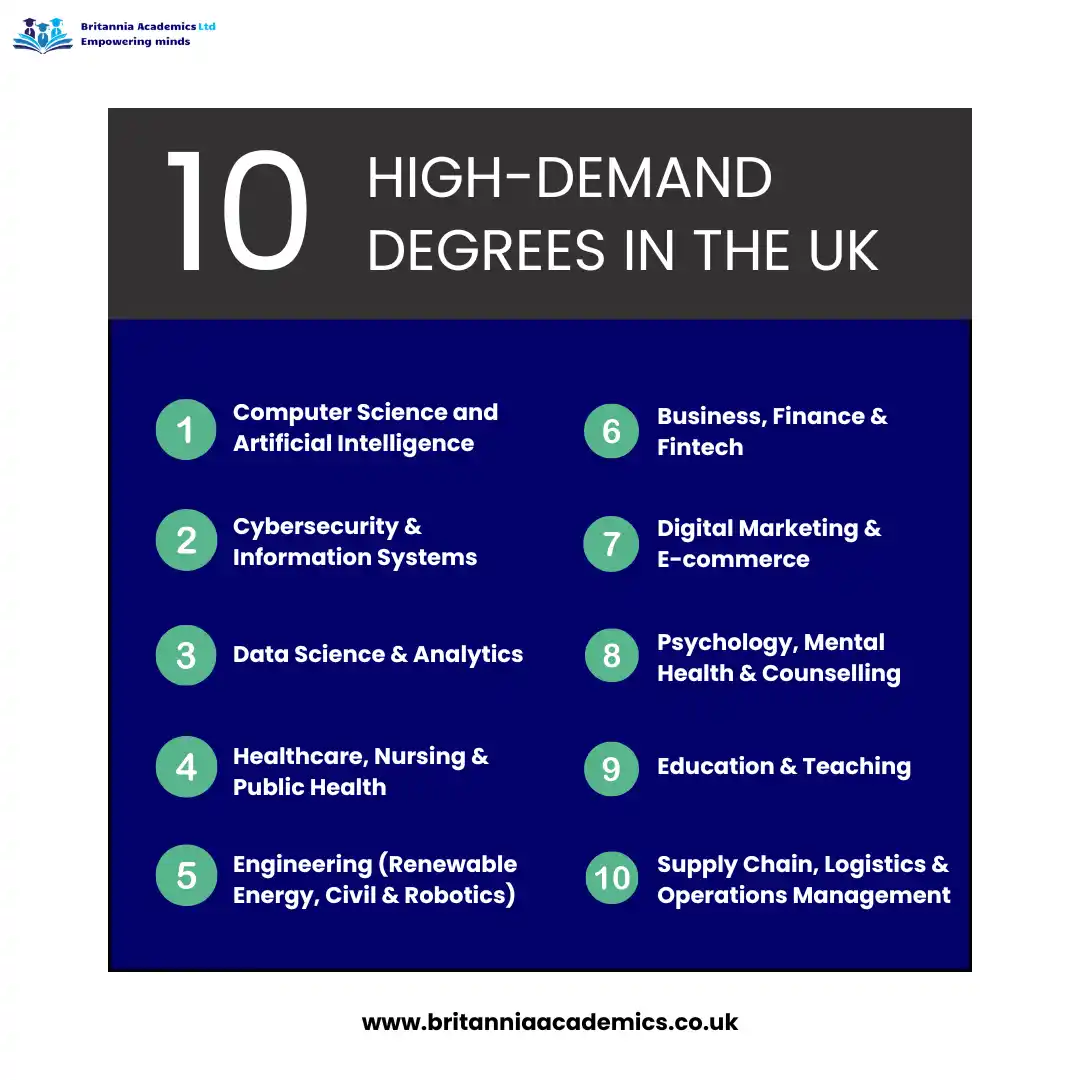
The most in-demand degrees in the UK for 2026 are Computer Science and AI, Cybersecurity, Data Science, Healthcare and Nursing, Engineering (especially Renewable and Civil), Business and Fintech, Digital Marketing, Psychology and Counselling, Education, and Supply Chain Management.
These degrees consistently show strong job growth, above-average graduate salaries, and long-term career stability.
In other words, a degree isn’t just an academic credential anymore—it’s an employability asset. Choosing the right field can lead to better job prospects, faster career progression, and greater job security in an increasingly competitive market.
A high-demand degree in the UK is one that aligns with rapidly growing sectors and skills shortages, offering strong employability and a future-proof career.
In short, a high-demand UK degree in 2026 combines employability, innovation, and resilience in a fast-changing job market.
👉Why it’s in demand:
AI and machine learning are being embedded across finance, healthcare, retail, transport, and public services; organisations need engineers and developers who design, implement, and maintain data-driven systems. PwC’s 2025 AI Jobs Barometer and other industry reports show substantial growth in AI-related job postings and rising organisational AI adoption.
👉Career paths:
Software developer, AI / machine-learning engineer, data scientist, systems architect, MLOps engineer.
👉Expected Salary: £35k–£42k.
👉Why it’s in demand:
Escalating cyber threats, tighter data-protection rules, and the digitisation of critical infrastructure keep cybersecurity roles high on employer priority lists. National programmes (NCSC) and government cyber growth plans emphasise skills development and sector expansion.
👉Career paths:
Security analyst, security engineer, penetration tester / ethical hacker, incident responder, information security officer, governance/compliance specialist.
👉Expected Salary: £50k–£55k.
👉Why it’s in demand:
Businesses across sectors rely on data to make decisions, optimise operations and personalise services. Demand for data roles continues to outpace that of many other job families; multiple industry reports predict strong year-over-year growth for data roles.
👉Career paths:
Data analyst, data scientist, business intelligence analyst, machine-learning modeller, analytics consultant, data engineer.
👉Expected Salary: £35k–£45k starting; rapid growth with experience.
👉Why it’s in demand:
An ageing population, ongoing NHS pressures, and public health priorities (including backlog recovery and mental health demand) keep healthcare degrees in urgent demand. Nursing shortages persist as a structural issue despite ongoing recruitment efforts.
👉Career paths:
Registered nurse (adult/children/mental health), public-health specialist, allied health professional, healthcare manager, advanced clinical practitioner.
👉Expected Salary: £31k (Band-5 NHS nurse).
👉Why it’s in demand:
The UK’s net-zero commitments, infrastructure renewal, and investment in renewable energy (including wind, solar, hydrogen, and grid upgrades) drive demand for civil, mechanical, electrical, and robotics engineers. Government clean-energy plans and ONS green jobs estimates indicate a rapid expansion of green roles.
👉Career paths:
Civil engineer, renewable-energy engineer/consultant, mechanical/electrical engineer, robotics engineer, structural engineer, systems design engineer.
👉Expected Salary: £33k–£45k starting.
👉Why it’s in demand:
The UK remains a global finance centre and fintech continues to disrupt payments, lending, wealthtech and compliance — creating jobs that require finance knowledge plus technical fluency (data, automation, blockchain). Reports show continued fintech hiring and investment in 2025.
👉Career paths:
Financial analyst, investment analyst, fintech product manager, risk/compliance analyst, quantitative analyst, corporate finance associate.
👉Expected Salary: £35k–£50k Starting.
👉Why it’s in demand:
Brands and retailers are digital-first: acquisition, retention, and measurement now rely on SEO, paid media, analytics, content, and e-commerce platforms. Demand for marketers who can combine creative strategy with data and tooling is high. Social and search remain dominant channels.
👉Career paths:
SEO/SEM specialist, digital marketing manager, e-commerce manager, content strategist, CRM/data marketing analyst, growth marketer.
👉Expected Salary: £25k–£40k (varies by agency vs in-house).
👉Why it’s in demand:
Mental health needs in the UK remain high, with NHS and private services experiencing rising demand and long wait times, creating a demand for qualified psychologists, therapists, and counsellors across health, education, and corporate wellbeing.
👉Career paths:
Clinical psychologist (postgraduate route), counselling psychologist, mental-health practitioner, educational psychologist, workplace wellbeing consultant.
👉Expected Salary: £30k–£50k+ depending on role and experience.
👉Why it’s in demand:
Teacher shortages, particularly in secondary STEM subjects and SEND (special educational needs and disabilities), along with policy incentives for recruitment, continue to drive demand for teaching degrees. Government bursaries, targeted recruitment, and pledges indicate ongoing priority.
👉Career paths:
Primary/secondary teacher (QTS pathway), subject specialist teacher (STEM), special needs teacher, educational psychologist (postgraduate), teaching assistant, school leader.
👉Expected Salary: £26k–£40k (depending on location and bursaries).
👉Why it’s in demand:
Post-Brexit trade rules, growth in e-commerce, and the need to make supply chains more resilient have pushed logistics and operations to the front of business strategy. Vacancy growth in logistics and warehousing increased in 2025, driven by investments in fulfilment and distribution.
👉Career paths:
Supply chain analyst, logistics manager, procurement specialist, operations manager, demand planner, transport/distribution manager.
👉Expected Salary: Typical supply-chain managers average reported salaries of around £42k–£56k, while planners and graduate trainees start at lower levels (~£25k–£33k); senior directors earn substantially more.

Choosing a degree is a big decision. Here’s how to approach it:
The UK’s job market in 2026 is driven by technology, sustainability, and healthcare innovation. Degrees in AI, data science, cybersecurity, engineering, and healthcare offer the best mix of growth, salary, and job security.
Choosing a degree today means balancing passion with employability. Focus on future-proof skills and adaptability to remain relevant in a rapidly changing market.
Computer Science, AI, Cybersecurity, Data Science, Healthcare, Engineering, Business & Fintech, Digital Marketing, Psychology, Education, and Supply Chain Management.
Computer Science, AI, Data Science, Engineering, and Finance degrees typically offer the highest graduate salaries.
Yes. STEM degrees remain highly sought after due to strong job growth, tech advancement, and high earning potential.
Focus on digital skills, continuous learning, AI & tech literacy, adaptability, networking, and gaining practical experience through internships and projects.
Quick Overview: UK higher education has its own set of...
Read MoreQuick Overview: UK higher education has its own set of...
Read MoreQuick Overview: UK higher education has its own set of...
Read MoreQuick Overview: UK higher education has its own set of...
Read More